
Many Canadian business owners feel the pressure when office printing costs start adding up, and finding the right solution can be a real puzzle. With American printing technologies shaping much of today’s options, understanding the big differences between toner and ink helps you avoid wasting money. Discover how selecting the ideal cartridge could impact your bottom line and why knowing what sets these materials apart could make your next purchase truly affordable. Over 60 percent of small businesses overspend on printer supplies each year.
| Point | Details |
|---|---|
| Ink vs. Toner | Choose ink for high-quality color graphics and toner for fast, high-volume text printing. |
| Cartridge Types | Consider OEM for reliability, compatible for cost savings, and remanufactured for eco-friendliness. |
| Cost Analysis | Analyze initial costs versus long-term expenses; toner generally offers lower cost per page. |
| Print Volume | Match printer technology to your printing needs: high-volume environments benefit from laser printers, while color-focused tasks favor inkjet. |
Printing technologies rely on two primary substances for transferring text and images onto paper: ink and toner. While they might seem similar at first glance, these printing materials have distinct characteristics and applications that significantly impact print quality, cost, and performance. Historically developed through technological innovations, these substances represent different approaches to creating printed documents.
Ink is a liquid-based printing material traditionally composed of pigments or dyes suspended in a carrier solution. Typically carbon-based, ink has roots in ancient writing techniques and is predominantly used in inkjet printers. The liquid nature of ink allows it to be sprayed through microscopic nozzles directly onto paper, creating vibrant colors and smooth gradients. Ink cartridges are generally less expensive upfront but can have higher per-page printing costs due to frequent replacements.
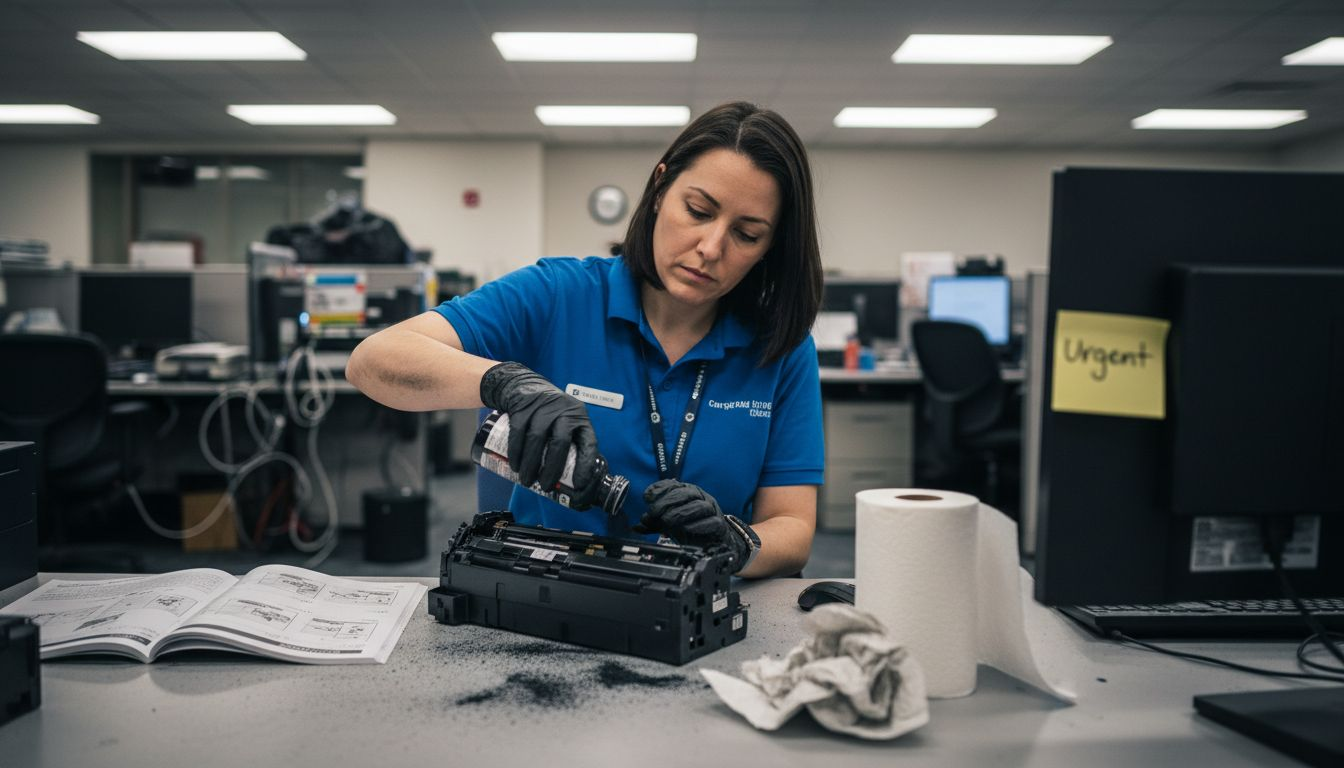
Toner, by contrast, is a fine powder material used primarily in laser printing technologies. Composed of plastic particles and pigments, toner operates through an electrostatic process where powder is precisely deposited and then fused onto paper using heat. This method produces sharp, durable prints that resist smudging and maintain crisp text quality. Laser printers using toner typically have higher initial equipment costs but lower long-term printing expenses due to more efficient powder distribution.
Pro tip: When selecting between ink and toner, calculate your expected monthly print volume to determine which technology offers the most cost-effective solution for your specific business needs.
Here’s a summary of key differences between ink and toner for business printing:
| Aspect | Ink (Inkjet) | Toner (Laser) |
|---|---|---|
| Print Quality | Vivid colors, smooth gradients | Crisp text, durable output |
| Print Speed | Slower, under 25 ppm | Faster, 20-50 ppm |
| Cost Efficiency | Lower initial cartridge cost | Lower cost per page long-term |
| Typical Use | Graphic materials, photos | High-volume text documents |
| Durability | Prone to smudging | Resistant to smudging |
| Maintenance | Frequent cartridge changes | Less frequent replacements |
Understanding the various types of printer cartridges is crucial for businesses seeking cost-effective and reliable printing solutions. Printer cartridge technologies offer multiple options that cater to different budget constraints and performance requirements, each with unique characteristics and advantages.
The first category is Original Equipment Manufacturer (OEM) cartridges, which are produced directly by printer manufacturers like HP or Brother. These cartridges guarantee optimal performance and compatibility with specific printer models. They typically provide the highest print quality and reliability but come at a premium price point. OEM cartridges are engineered precisely for their corresponding printer models, ensuring consistent output and minimizing potential technical complications.
Compatible cartridges represent a more economical alternative for budget-conscious businesses. These third-party manufactured cartridges are designed to match OEM specifications while offering significant cost savings. Manufactured by independent companies, compatible cartridges undergo rigorous testing to ensure they meet industry standards. Compatible toner options can reduce printing expenses by 30-50% compared to brand-name alternatives without substantially compromising print quality.
The third category includes remanufactured cartridges, which are recycled OEM cartridges that have been professionally cleaned, refilled, and tested. These environmentally friendly options provide an excellent balance between cost efficiency and sustainability. Remanufactured cartridges undergo extensive quality control processes, with components replaced to ensure reliable performance. By choosing remanufactured options, businesses can reduce waste and lower their environmental impact while maintaining reasonable print quality.
Pro tip: Always request print quality samples and verify warranty terms when exploring alternative cartridge options to ensure compatibility with your specific printing equipment.
This table consolidates cartridge type benefits and considerations for easy reference:
| Cartridge Type | Main Advantage | Potential Drawback |
|---|---|---|
| OEM | Highest reliability, best compatibility | High cost compared to alternatives |
| Compatible | Major cost savings, wide availability | Variable print quality risk |
| Remanufactured | Eco-friendly, cost-effective | Inconsistent page yield potential |
Printing technologies have revolutionized document production through two primary mechanisms: inkjet and laser printing. Each technology offers unique approaches to transferring digital images and text onto physical media, with distinct operational principles that impact print quality, speed, and overall performance.
Inkjet Printing operates through a precise mechanism of liquid ink distribution. Microscopic nozzles spray tiny droplets of ink directly onto paper, creating images through a complex pattern of controlled ink placement. These printers excel at producing high-resolution color graphics and photographs, with nozzles typically ranging from 50 to 300 per inch. The liquid ink allows for smooth color gradients and exceptional detail, making inkjet printers ideal for graphic-intensive tasks like marketing materials, photography, and design proofs.
Laser Printing employs an entirely different technological approach. A laser beam precisely scans an electrically charged drum, creating an electrostatic image that attracts powdered toner. The toner is then transferred and permanently fused to paper through intense heat, resulting in crisp, fast, and durable prints. Laser printers are engineered for high-volume text documents, offering remarkable speed and consistency. They typically produce 20-50 pages per minute, making them perfect for office environments that require rapid, professional-quality document production.
Pro tip: Match your printer technology to your primary printing needs: choose inkjet for color-rich graphics and laser for high-volume text documents to optimize both print quality and operational efficiency.
Print technologies diverge significantly in performance characteristics, presenting distinct advantages for specific business printing requirements. Understanding these nuanced differences enables organizations to make strategic equipment investments that align with their operational needs and budget constraints.
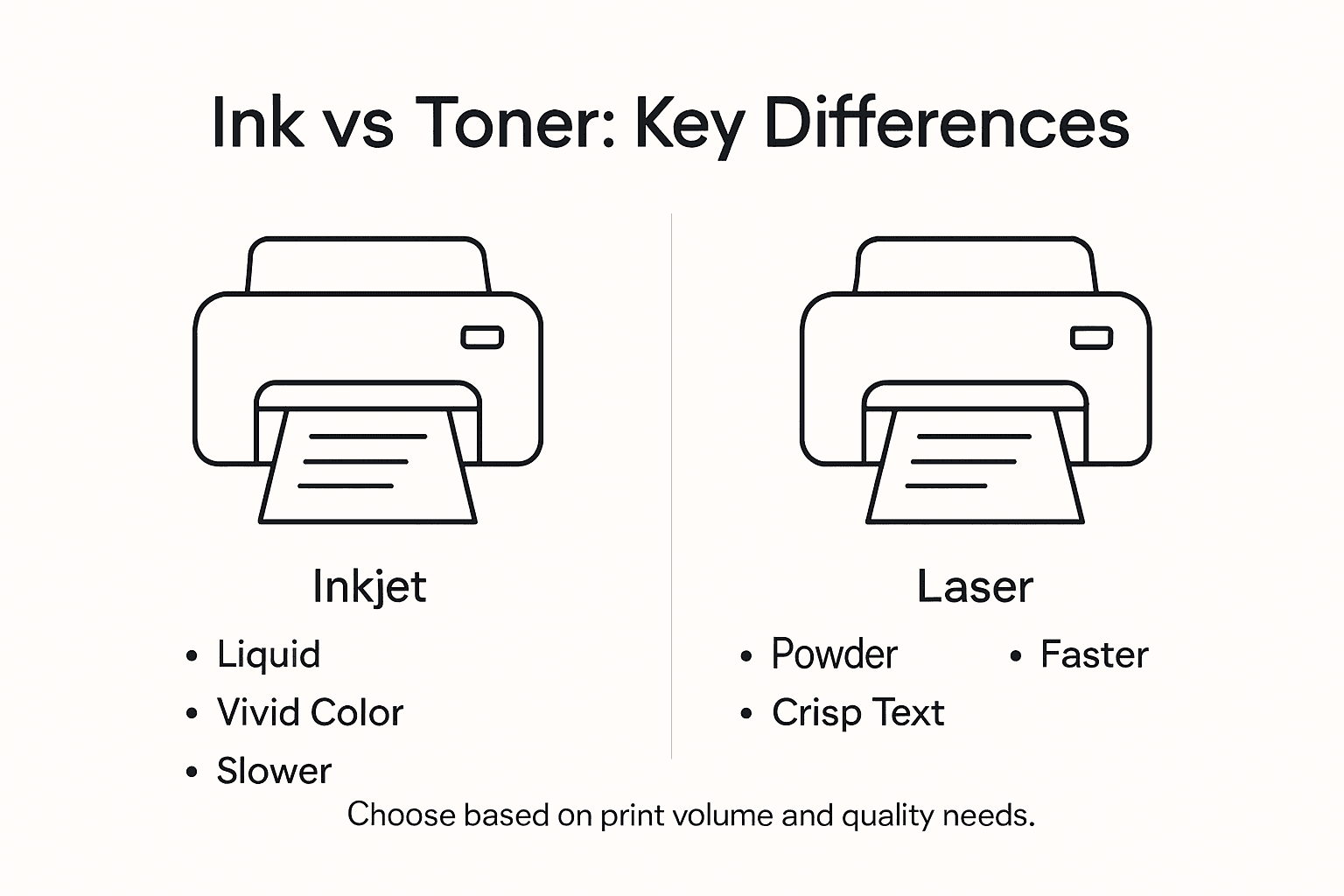
Print Quality represents the most critical differentiator between inkjet and laser technologies. Inkjet printers excel in producing photorealistic images with vibrant color reproduction, making them ideal for graphic-intensive applications like marketing materials, photography, and design presentations. The microscopic ink droplet placement allows for exceptional color gradation and detail. Laser printers, conversely, specialize in crisp, consistent text documents with sharp black-and-white output, delivering professional-grade text reproduction that maintains clarity across high-volume printing tasks.
Print Speed dramatically separates these technologies in commercial environments. Laser printers dominate high-volume printing scenarios, consistently producing 20-40 pages per minute with remarkable efficiency. Inkjet printers typically operate at slower rates, averaging under 25 pages per minute, which can create bottlenecks in time-sensitive business operations. This speed differential makes laser printers substantially more suitable for offices requiring rapid document production, while inkjet remains preferable for quality-focused, lower-volume color printing needs.
Application Considerations further illuminate the strategic choice between these technologies. Laser printers shine in environments demanding durability, consistency, and rapid text document generation, such as legal offices, academic institutions, and corporate settings. Inkjet printers find their niche in creative industries, small design firms, and scenarios prioritizing color accuracy and photographic reproduction. The selection ultimately depends on understanding your specific printing volume, quality requirements, and budgetary constraints.
Pro tip: Conduct a comprehensive print audit tracking your organization’s monthly print volume, color versus black-and-white ratios, and primary document types to make an informed printer technology selection.
Printer cartridge expenses represent a critical consideration for businesses seeking cost-effective printing solutions. Understanding the nuanced financial implications of ink versus toner technologies can significantly impact an organization’s operational budget and long-term printing strategy.
Initial Investment Costs reveal a complex economic landscape. Ink cartridges typically present a lower upfront expense, making them attractive for small businesses and individual users with limited printing needs. These cartridges have a more modest purchase price, creating an initial perception of affordability. Laser printers and toner cartridges, conversely, demand a higher initial investment, with equipment and consumables costing substantially more at the point of purchase.
Per-Page Printing Expenses tell a different financial story. Toner cartridges demonstrate remarkable efficiency, delivering significantly lower costs per page compared to ink cartridges. A single toner cartridge can produce substantially more pages before requiring replacement, often ranging from 2,000 to 10,000 pages depending on the model. Ink cartridges, while cheaper initially, require more frequent replacements and typically yield fewer pages, resulting in higher cumulative printing expenses over time. This economic dynamic makes toner a more financially prudent choice for businesses with consistent, high-volume printing requirements.
Total Cost of Ownership encompasses more than just cartridge prices. Businesses must consider equipment longevity, maintenance expenses, and operational efficiency. Laser printers using toner generally offer more robust hardware, longer operational lifespans, and lower maintenance requirements. The consistent print quality and reduced downtime further contribute to their overall economic advantage, particularly in professional environments where reliability directly impacts productivity.
Pro tip: Calculate your organization’s monthly print volume and compare the total cost of ownership between ink and toner technologies, factoring in cartridge costs, replacement frequency, and equipment durability before making a final purchasing decision.
Business printing solutions demand strategic technology selection based on specific operational requirements and anticipated print volumes. Understanding the nuanced differences between ink and toner technologies enables organizations to make informed decisions that align with their unique productivity needs.
Printing Volume Considerations form the foundational criteria for technology selection. High-volume business environments with extensive document production should prioritize laser printers and toner cartridges. These systems offer remarkable efficiency, producing 20-40 pages per minute with consistent quality and minimal downtime. Small businesses or departments with intermittent, color-intensive printing needs might find inkjet technologies more suitable, particularly when graphic quality and versatility are paramount.
Operational Context plays a critical role in determining the most appropriate printing technology. Businesses must evaluate their specific use cases to make an intelligent selection. Legal firms, academic institutions, and corporate offices requiring rapid text document generation will benefit from laser printer capabilities. Creative agencies, design studios, and marketing departments needing exceptional color reproduction and photographic printing will find inkjet technologies more aligned with their aesthetic and technical requirements.
Budget and Long-Term Strategy should guide the final decision. While initial investment costs differ, businesses must consider total cost of ownership, including cartridge expenses, replacement frequency, and equipment durability. Toner-based systems typically offer lower per-page printing costs and longer-lasting hardware, making them economically advantageous for consistent, high-volume printing environments. Inkjet printers present a more attractive option for organizations with sporadic printing needs and budget constraints.
Pro tip: Conduct a comprehensive print audit documenting your organization’s monthly print volume, color versus black-and-white ratios, and primary document types to make a data-driven printer technology selection.
Choosing between toner and ink can be confusing when managing your business printing needs. You want reliable, cost-effective solutions that match your monthly print volume and quality expectations. This article explains key differences like print speed, cost per page, and durability that impact your printing strategy. At GetToner.ca, we understand these challenges and offer a wide selection of OEM and compatible ink and toner cartridges to help you strike the perfect balance between quality and value.
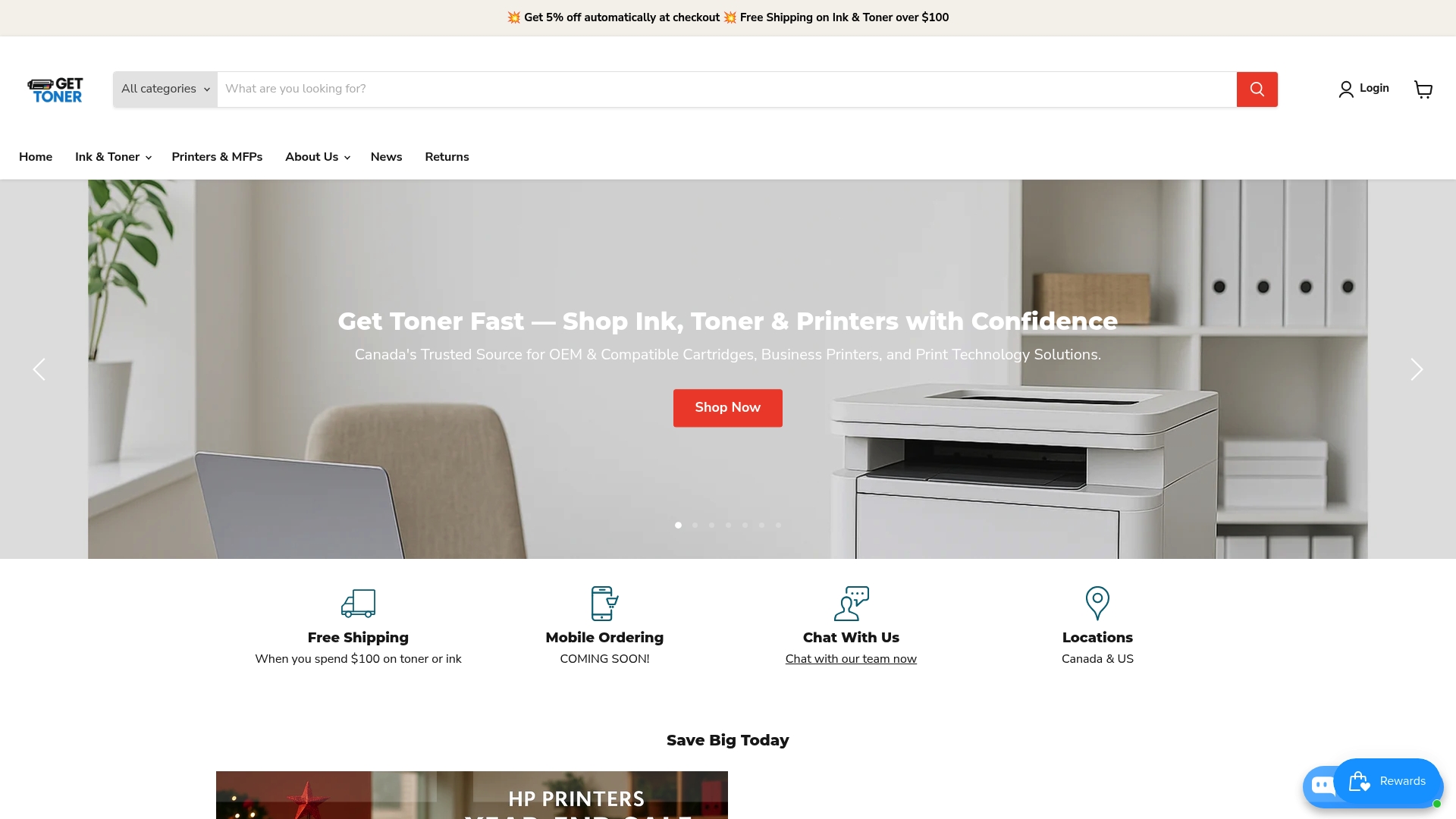
Explore our extensive range of affordable cartridges and printers tailored for every business size. Benefit from free shipping on orders over $100, automatic discounts, and trusted brands like HP and Brother through our Canadian-based support team. Start optimizing your printing costs today by visiting GetToner.ca and discover solutions designed to grow with your business. Check out our selection of ink cartridges and toner cartridges now to make informed choices with confidence.
Toner is a fine powder used in laser printers, while ink is a liquid used in inkjet printers. Toner is fused onto paper using heat, producing sharp, durable prints, whereas ink is sprayed onto paper, creating vibrant colors and gradients.
Toner is generally more cost-effective for high-volume printing due to its lower per-page cost and longer lifespan. Laser printers that use toner produce significantly more pages before requiring a cartridge replacement compared to inkjet printers.
Inkjet printers excel in producing high-resolution color graphics and photographs, making them ideal for creative tasks such as marketing materials, photography, and design proofs due to their ability to create smooth color gradients.
Inkjet printers often require more frequent cartridge changes and maintenance due to the liquid nature of ink, which can dry out. In contrast, laser printers using toner typically require less frequent replacements, resulting in lower maintenance needs overall.