

Most office managers are surprised to learn that printing can eat up as much as three percent of annual business revenue, rivaling the costs of some American technology services. For Canadian small and medium-sized businesses, controlling print expenses goes far beyond juggling paper and ink supplies. If you want clearer budgets, fewer wasteful practices, and high-quality results, understanding the real drivers behind print costs is the first step toward smarter management.
| Point | Details |
|---|---|
| Understanding Print Costs | Analyzing print expenses requires assessing various factors like equipment, consumables, and efficiency. |
| Cost Management Strategies | Implementing print quotas and conducting regular audits can identify waste and control expenditures. |
| Impact of Unmanaged Printing | Uncontrolled printing can lead to hidden costs, operational inefficiencies, and security risks. |
| Benefits of Managed Print | Managed print solutions optimize costs, enhance security, and improve employee productivity through monitoring. |
Print costs represent a complex and often overlooked expense for small and medium-sized businesses across Canada. Understanding these costs requires more than simply tracking ink and paper purchases. Businesses must analyze multiple interconnected factors that contribute to their overall printing expenditure, including equipment type, consumables, maintenance, and operational efficiency.
The core of print cost management starts with understanding the price per page dynamics. Different printer technologies dramatically impact per-page expenses. Laser printers typically offer more economical high-volume printing, while inkjet printers might be preferable for lower-volume or specialized color document needs. Paper quality, print resolution, and document type further influence these calculations, creating a nuanced cost structure that demands strategic evaluation.
Federal cost accounting principles provide additional guidance for businesses seeking to categorize print expenses. Companies can distinguish between direct printing costs assigned to specific projects and indirect administrative printing expenses. This classification helps organizations develop more precise budgeting strategies and control spending. Understanding these cost classification frameworks enables SMBs to implement more rigorous financial management practices around their printing infrastructure.
Pro tip: Track your print volume and per-page costs monthly to identify optimization opportunities and potential waste in your printing workflow.
Business print expenses extend far beyond the simple cost of paper and ink. Identifying and understanding cost drivers provides small and medium-sized businesses with critical insights into managing their printing infrastructure. Cost drivers represent key factors that trigger changes in printing expenditures, influencing both direct and indirect expenses across an organization.
These cost drivers can be categorized into several primary components. Equipment-related expenses include printer acquisition, maintenance, and replacement costs. Consumable expenses cover toner, ink cartridges, and paper supplies. Operational costs involve electricity consumption, network connectivity, and printer management software. Labor costs also factor in, encompassing time spent on print-related tasks like troubleshooting, supply ordering, and device maintenance.

Companies can leverage print quotas and usage tracking to control expenses more effectively. By implementing strategic monitoring systems, businesses can identify inefficient printing practices, reduce unnecessary color printing, and optimize device usage across departments. Understanding these nuanced cost drivers allows organizations to develop targeted strategies for minimizing print-related expenditures while maintaining operational efficiency.
Pro tip: Conduct a comprehensive print audit quarterly to track usage patterns, identify waste, and realign printing resources with actual business needs.
Here is a summary comparing common print expense types and their main business impacts:
| Expense Type | Example Costs | Business Impact |
|---|---|---|
| Equipment | Printer purchase, repairs | High upfront and maintenance costs |
| Consumables | Toner, ink, paper | Ongoing, variable operational costs |
| Operational | Power, software licenses | Impacts device availability |
| Labor | Admin time, troubleshooting | Reduces workforce productivity |
Unmanaged printing represents a silent but significant financial drain for small and medium-sized businesses. Inefficient printing practices can create substantial hidden costs that erode a company’s bottom line, often without leadership even recognizing the extent of the problem. These expenses manifest through excessive paper consumption, unnecessary toner use, and reduced employee productivity across multiple operational dimensions.
The consequences of uncontrolled printing extend beyond direct financial impacts. Businesses face significant workflow disruptions, increased security vulnerabilities, and environmental waste. Untracked print environments can lead to unauthorized document printing, sensitive information exposure, and inefficient resource allocation. Digital integration challenges compound these issues, making it difficult for SMBs to implement effective print management strategies that balance cost control with operational flexibility.
Moreover, unmanaged printing creates systemic inefficiencies that ripple through an organization. Employees might print unnecessary documents, waste expensive color toner, or fail to implement digital alternatives that could streamline workflows. These behaviors not only increase direct printing costs but also contribute to broader operational inefficiencies that can hamper business agility and competitiveness. Small businesses, with limited resources, are particularly vulnerable to these cumulative printing-related expenses.
Pro tip: Implement a quarterly print audit to track usage patterns, identify waste sources, and establish clear printing guidelines for your team.
Successful print cost management requires a comprehensive and strategic approach. Digital workflow alternatives provide the most immediate and impactful pathway to reducing printing expenses. By transitioning from traditional paper-based processes to electronic document management, businesses can dramatically cut consumable costs, minimize waste, and improve overall operational efficiency.
Implementing targeted print reduction policies involves multiple interconnected strategies. Companies should start by conducting a thorough print usage assessment, establishing clear guidelines for document production, and investing in technology that supports electronic collaboration. Key tactics include encouraging duplex printing, setting default printer configurations to draft mode, consolidating print jobs, and promoting digital sharing platforms that minimize hard copy generation.
Technology and employee education play crucial roles in sustainable print cost reduction. Comprehensive business guides recommend creating awareness about printing impacts, implementing monitoring systems, and developing organizational cultures that prioritize digital efficiency. This might involve training programs that highlight the financial and environmental benefits of reduced printing, installing print tracking software, and creating incentive structures that reward departments demonstrating exceptional print resource management.
Pro tip: Implement a print tracking system that provides real-time insights into your organization’s printing habits and automatically generates cost-saving recommendations.
Managed print services represent a transformative approach for small and medium-sized businesses seeking comprehensive printing optimization. Streamlined device management enables organizations to control printing resources strategically, reducing operational complexity and minimizing unnecessary expenses. These solutions go beyond simple cost reduction, providing businesses with advanced tools to monitor, analyze, and optimize their entire printing infrastructure.
The financial advantages of managed print solutions are substantial and multifaceted. By implementing centralized print management systems, companies can achieve predictable budgeting, reduce equipment downtime, and eliminate hidden print-related costs. Turnkey print services offer right-sized equipment procurement, proactive maintenance, and supply management under flexible, low cost-per-page models. This approach allows businesses to transform unpredictable printing expenses into a structured, manageable operational cost.
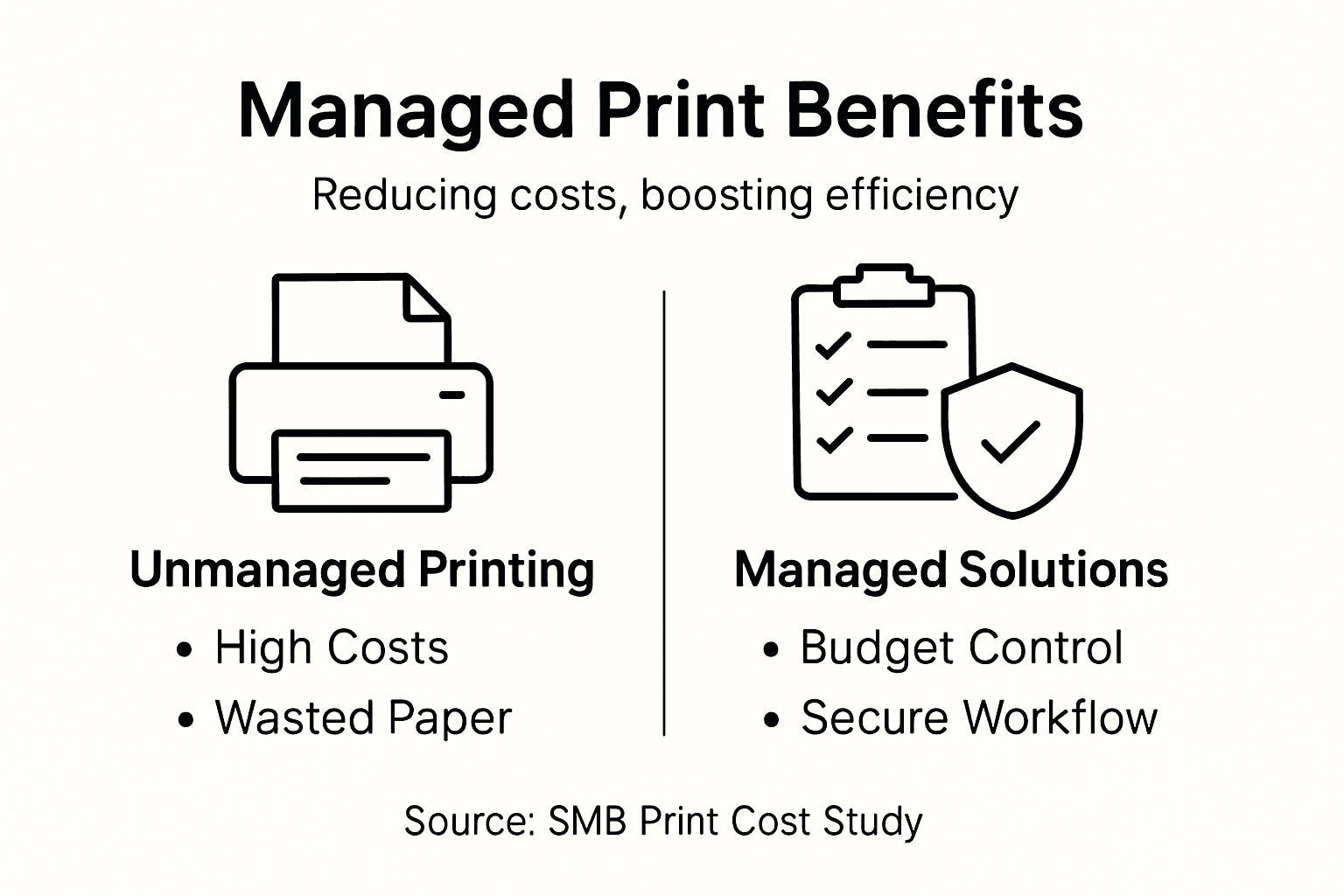
Moreover, managed print solutions deliver significant secondary benefits beyond financial savings. Enhanced security features like controlled print job release, reduced environmental footprint through optimized device usage, and improved employee productivity create a comprehensive value proposition. Organizations gain real-time insights into printing behaviors, enabling data-driven decisions that support both economic and sustainability objectives. The ability to track, analyze, and optimize print resources becomes a strategic advantage in modern business operations.
Pro tip: Request a comprehensive print audit from your managed print service provider to uncover hidden inefficiencies and potential cost-saving opportunities.
This table compares unmanaged and managed print environments for small businesses:
| Factor | Unmanaged Printing | Managed Print Solutions |
|---|---|---|
| Cost Predictability | Expenses often unpredictable | Costs are monitored and forecasted |
| Security Risks | Higher, less control | Lower, with job authentication |
| Environmental Impact | More waste and inefficiency | Reduced waste, better tracking |
| Employee Productivity | Lower, frequent disruptions | Higher, stable systems and tools |
Successful long-term print cost management requires more than initial implementation. Strategic sustainability planning demands continuous effort, stakeholder engagement, and adaptive approaches that evolve with organizational needs. Small and medium-sized businesses must develop a comprehensive vision that extends beyond immediate cost reduction, focusing on creating systemic changes in printing behaviors and infrastructure.
Implementing robust monitoring mechanisms is crucial for maintaining print cost savings. Print quota systems provide an effective framework for tracking and controlling printing expenses. By establishing periodic quota resets, creating user alerts, and developing flexible funding mechanisms, organizations can create accountability and discourage wasteful printing practices. These systems enable real-time insights into print consumption, allowing businesses to make data-driven adjustments that preserve financial benefits.
Resource sharing and collaborative approaches further enhance the sustainability of print cost reduction strategies. Engaging employees through transparent communication, providing training on efficient printing practices, and creating incentive structures that reward conservation can transform cost-saving initiatives from temporary measures to ingrained organizational culture. By marketing the value of these initiatives and demonstrating tangible economic and environmental benefits, businesses can maintain momentum and ensure long-term success in print resource management.
Pro tip: Develop a quarterly review process that analyzes print usage data, tracks cost savings, and identifies emerging optimization opportunities.
Managing print expenses effectively is essential for small and medium-sized businesses looking to maximize savings and improve operational efficiency. The challenges of balancing equipment costs, consumables, and labor highlighted in the article show how unmanaged printing can drain resources through waste and unpredictability. Recognizing key cost drivers and adopting strategic management strategies can transform printing from a costly burden into an asset.
GetToner.ca offers the perfect solution for businesses seeking affordability and reliability in printing supplies and equipment across Canada. Explore our wide selection of OEM and compatible ink and toner cartridges as well as printers and multifunction devices designed to fit your specific needs. Take advantage of competitive pricing, automatic discounts, and free shipping on orders over $100 to reduce your overall print expenses today. Start optimizing your print environment and discover how controlled purchasing and quality products can support your cost-saving goals by visiting GetToner.ca now. Empower your business with smart print solutions that deliver both financial and operational benefits.
Multiple factors contribute to print costs, including equipment type, consumables like ink and paper, maintenance expenses, and operational efficiency. Analyzing these interconnected elements is essential for effective cost management.
Tracking print volume and costs can be achieved by monitoring prints monthly and implementing usage tracking systems. This helps identify optimization opportunities and reduce waste in the printing workflow.
Managed print solutions offer centralized management, predictable budgeting, enhanced security, and improved employee productivity, leading to significant cost savings and operational efficiency for businesses.
To reduce print costs, consider adopting digital workflow solutions, conducting print audits, encouraging duplex printing, and educating employees about cost-effective printing practices. Regular monitoring of usage will help sustain these savings.