
Only 15 percent of Canadian businesses consistently use OEM toner, despite its well-known impact on print reliability compared to many American alternatives. For small and medium-sized offices in Canada, every print job matters, whether you are handling contracts or client proposals. In this article, you will discover how choosing cost-effective OEM toner keeps your printing sharp, protects your printer investment, and avoids the costly setbacks that come from using lower-quality supplies.
| Point | Details |
|---|---|
| OEM Toner vs. Alternatives | OEM toner is designed specifically for printer models, ensuring optimal print quality and equipment reliability. |
| Cost Analysis | While OEM toner may have a higher upfront cost, it prevents hidden expenses associated with poor quality and printer damage. |
| Warranty Considerations | Using OEM toner typically preserves printer warranties, while non-OEM options may void them, leading to costly repairs. |
| Common Selection Mistakes | Businesses often overlook compatibility, leading to performance issues; always verify printer model requirements before purchasing non-OEM toner. |
Original Equipment Manufacturer (OEM) toner is a specialized printing supply designed by manufacturers specifically for their printer models. Toner cartridges contain precise plastic particles that create printed images with exceptional clarity and consistency. Unlike generic alternatives, OEM toner is engineered to match the exact specifications of a particular printer brand and model.
The primary purpose of OEM toner is to deliver optimal printing performance and maintain the integrity of your printing equipment. Manufacturers produce these components to ensure maximum compatibility, reliability, and print quality. This means when you use OEM toner, you’re using a product specifically designed to work seamlessly with your printer’s internal mechanisms.
OEM toner cartridges typically include several critical components that differentiate them from third-party alternatives:
Businesses and professionals choose OEM toner because it minimizes potential printing issues like streaking, uneven coverage, and equipment damage. These cartridges undergo rigorous quality control processes that generic alternatives cannot match.
Pro tip: Always verify your specific printer model before purchasing OEM toner to ensure complete compatibility and optimal performance.
Toner cartridges come in multiple varieties, each with distinct characteristics and performance implications for businesses and individual users. Different cartridge classifications exist ranging from original manufacturer (OEM) to third-party alternatives that can significantly impact printing quality and equipment reliability.
The primary types of toner cartridges include:
Each cartridge type presents unique advantages and potential drawbacks. Cartridge disposal requirements vary depending on their classification, with empty and non-empty cartridges requiring different handling procedures. OEM cartridges typically offer the most consistent performance, while compatible and remanufactured options provide more economical alternatives for budget-conscious consumers.
Businesses must carefully evaluate their specific printing needs, balancing factors like print quality, cost-effectiveness, and potential equipment warranty implications when selecting toner cartridge types. The choice between OEM and alternative cartridges depends on individual priorities such as budget constraints, print volume, and desired output quality.
Here’s a comparison of toner cartridge types and their practical impact for businesses:
| Cartridge Type | Typical Cost | Impact on Printer Warranty | Reliability for High-Volume Printing |
|---|---|---|---|
| OEM | Highest | Fully preserved | Superior, consistent output |
| Compatible | Lower | May void warranty | Variable, sometimes inconsistent |
| Remanufactured | Moderate | Usually not supported | Quality depends on refurbishing |
| Refill Kit | Lowest | Not supported | May cause printer issues |
Pro tip: Always check your printer’s warranty terms before using non-OEM toner cartridges to prevent potential equipment damage or voided manufacturer support.
Print quality depends critically on the precision and consistency of toner cartridges. Toner cartridges are engineered with sophisticated powder compositions that directly impact image sharpness, color accuracy, and overall document appearance. Original Equipment Manufacturer (OEM) toner represents the gold standard in maintaining exceptional printing performance.
The key components that distinguish OEM toner’s quality include:
Manufacturing quality systems ensure that OEM toner meets rigorous performance standards. Manufacturers implement extensive quality checks throughout production, guaranteeing that each cartridge produces crisp text, vibrant graphics, and reliable printing results. These stringent processes prevent common issues like uneven coverage, smudging, and premature printer wear.

Professional print environments require consistent output quality. OEM toner provides predictable performance by matching exact printer specifications, which means reduced equipment stress, fewer maintenance interruptions, and professional-grade documents every time. The investment in quality toner translates directly into superior print reliability and long-term equipment preservation.
Pro tip: Store your OEM toner cartridges in a cool, dry environment and keep them sealed until use to maintain optimal print quality and extend cartridge lifespan.
Printer warranties represent a critical factor in protecting your technology investment, especially when selecting toner cartridges. Reliability is defined as a product’s ability to maintain consistent quality under expected usage conditions, and OEM toner cartridges excel in this critical area.
Key warranty considerations for OEM toner include:
Consumer warranty protections provide essential safeguards that differentiate OEM toner from third-party alternatives. These warranties typically outline specific remedies for performance issues, ensuring businesses and individuals can rely on consistent, high-quality printing without unexpected expenses or disruptions. Non-OEM cartridges often lack such robust protection, potentially exposing users to higher long-term risks.
Professional print environments demand predictable, reliable output. By choosing OEM toner, organizations minimize potential equipment damage, reduce unexpected maintenance costs, and maintain professional document quality. The upfront investment in OEM toner translates into improved operational reliability and reduced potential for costly printer repairs or replacements.
Pro tip: Always register your printer and retain original purchase documentation to ensure maximum warranty coverage and simplify potential future claims.
Cost analysis of printer supplies extends far beyond the initial purchase price. Hidden expenses can dramatically impact total operational spending, making OEM toner a strategic financial investment for businesses seeking long-term reliability.
The potential financial risks of non-OEM toner cartridges include:
Consumer protection guidelines highlight the substantial financial risks associated with choosing non-OEM alternatives. While generic cartridges might appear less expensive initially, they frequently result in higher cumulative expenses through increased equipment stress, inconsistent print performance, and potential printer malfunction. Professional organizations must consider the comprehensive financial impact, not just the immediate per-cartridge pricing.
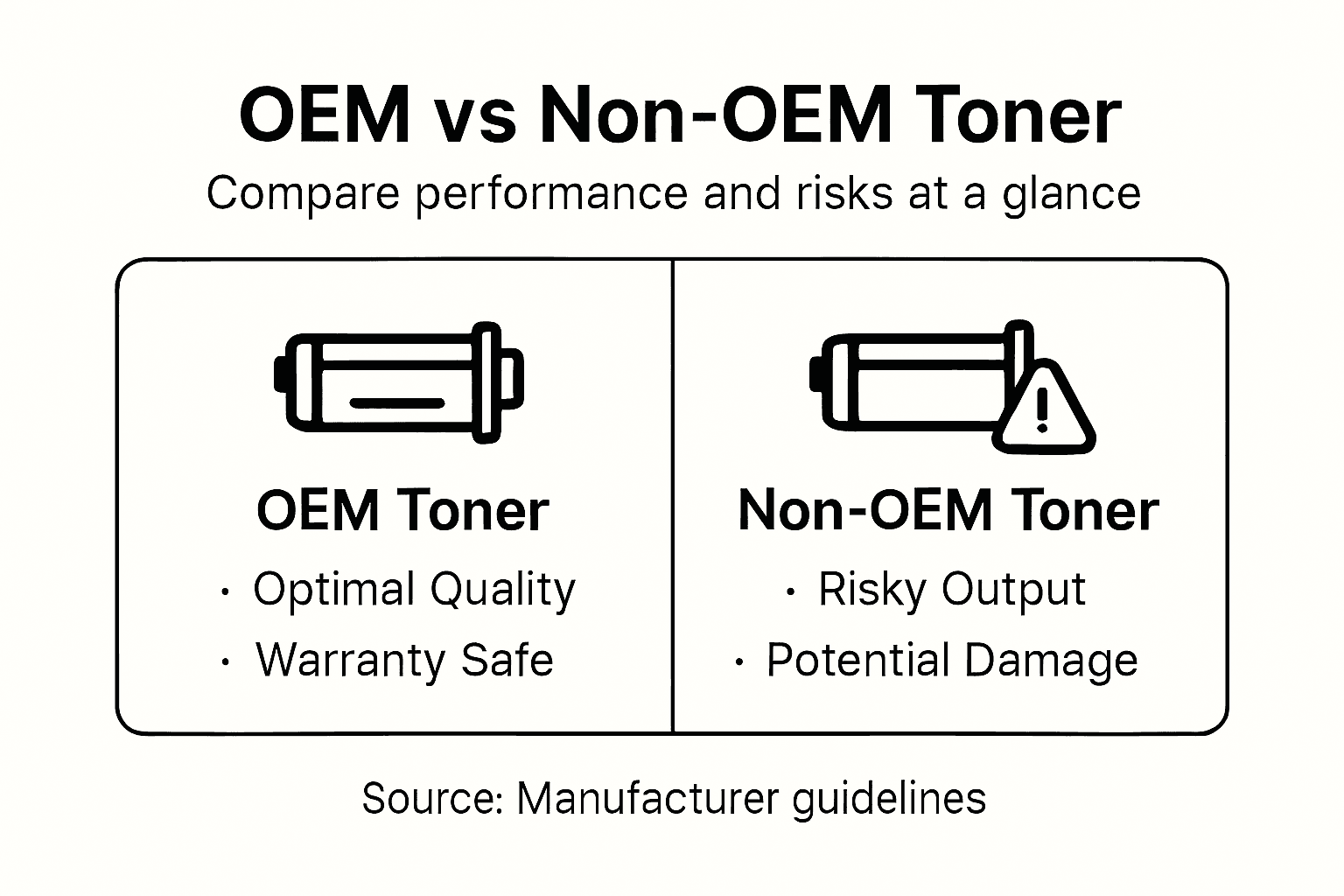
Calculating the true cost involves examining direct and indirect expenses. OEM toner provides predictable performance, consistent print quality, and reduced risk of unexpected repair costs. Small to medium businesses can minimize financial uncertainty by selecting manufacturer-recommended toner cartridges that protect both printing equipment and operational efficiency.
The table below summarizes key financial risks businesses face with non-OEM toner decisions:
| Risk Category | Short-Term Effect | Long-Term Consequence |
|---|---|---|
| Print Quality Issues | Reprints, delays | Higher supply expenses |
| Printer Damage | Repairs required | Reduced equipment lifespan |
| Warranty Loss | No support on failures | Out-of-pocket repairs |
| Productivity Loss | Unexpected downtime | Lower overall output |
Pro tip: Track your actual printing costs per page, including potential reprint expenses and equipment maintenance, to make a truly informed purchasing decision.
Printer supply decisions can have significant consequences for businesses and individual users. Toner cartridge compatibility challenges create numerous potential pitfalls that can compromise printing performance, equipment integrity, and overall operational efficiency.
The most critical mistakes when selecting non-OEM toner include:
Environmental and regulatory considerations further complicate non-OEM toner choices. Many businesses mistakenly believe that generic cartridges are equivalent, without understanding the complex technical and legal implications. Non-OEM alternatives can introduce significant risks, including inconsistent print performance, potential equipment damage, and unexpected disposal challenges.
Professional organizations must recognize that saving a few dollars on toner can result in substantially higher expenses through reprints, equipment repairs, and reduced productivity. The seemingly economical choice of non-OEM toner often conceals multiple hidden costs and potential operational disruptions that far outweigh initial savings.
Pro tip: Before purchasing any non-OEM toner, request a comprehensive compatibility test and detailed performance guarantee to mitigate potential risks.
The article highlights critical challenges like print quality issues, potential equipment damage, and warranty risks when using non-OEM toner. Your goal is clear: maintain consistent professional-grade prints, preserve your printer’s reliability, and avoid hidden costs that can drain your budget. Using OEM toner designed for your exact printer model is the safest way to achieve these outcomes. At GetToner.ca, we understand that protecting performance and value means choosing supplies that guarantee compatibility and durability.
Explore our wide selection of OEM and compatible toner cartridges designed for Canadian consumers and businesses. With GetToner.ca you get more than just quality products. Benefit from competitive prices, free shipping on orders over $100, and expert support from a Canadian team who knows your needs. Stay confident knowing you are purchasing from an authorized reseller of major brands such as HP and Brother.
Don’t risk print failures or costly repairs by settling for less than genuine OEM toner. Visit GetToner.ca today to secure the right cartridges for your printer. Take advantage of our special offers now and keep your printing crisp and reliable. Browse our collection and experience hassle-free, affordable printing solutions tailored for you.
OEM toner stands for Original Equipment Manufacturer toner, which is specifically designed for compatibility with a manufacturer’s printer models. It ensures optimal performance, print quality, and longevity of your printing equipment.
OEM toner generally provides superior print quality, reliability, and adherence to printer specifications compared to compatible or remanufactured cartridges, which may present risks like inconsistent performance and potential equipment damage.
Yes, using non-OEM toner can void your printer’s warranty, as manufacturers often specify that only OEM products should be used to maintain warranty coverage and prevent potential damage to the equipment.
Hidden costs can include diminished print quality leading to document reprints, increased maintenance and repair expenses, potential warranty voiding, and overall lower page yields, ultimately making non-OEM toner more expensive in the long run.